- contact@insightaml.com
The platform
Everything an AML investigation needs, in one place
From the monitoring rule to the decision record. Each capability below is in the product today, shown on the demo bank’s data.
Monitoring rules
Ten typologies, explained in one table
The parameters are the demo’s illustrative defaults. A bank sets its own from its risk assessment and tunes them on its own outcomes.
| Rule | Typology | What it looks for | Default parameters (illustrative) |
|---|---|---|---|
| Structuring | structuring | Cash deposits just under the reporting threshold, several within days | $8,000–$10,000, 3 or more within 14 days |
| Rapid movement / pass-through | layering | Large credits mostly paid out again within days, more than once | credits of $25,000+, 80% out within 3 days, twice |
| High-risk geography | high-risk geography | Wires with a jurisdiction on the bank’s high-risk or prohibited list | $10,000 in total; prohibited: any amount |
| Round amounts | layering | Many large transfers in exact round amounts | 5+ multiples of $1,000 of $5,000+ in 30 days, 30% of large transfers |
| Velocity against profile | profile deviation | Credits in 30 days far above the declared monthly credits | 3 times declared, at least $25,000 |
| Funnel account | funnel account | Many different people paying in, most of it wired out again | 8+ sources in 30 days, 70% wired out |
| Dormant reactivation | dormant reactivation | No activity for months, then large credits | 180 days idle, then $20,000+ in 30 days |
| Cash-intensive pattern | cash intensive | A cash share of credits well above what the customer declared | 30 points over declared, $30,000+ cash |
| Trade pricing anomaly | trade-based | Invoices priced far outside the reference band for the goods | 2.5 times above or below the band |
| Watchlist-adjacent counterparty | sanctions nexus | Payments with a counterparty a registry connects to a watchlist entry | any payment |
Transaction monitoring
Ten rules that show their working
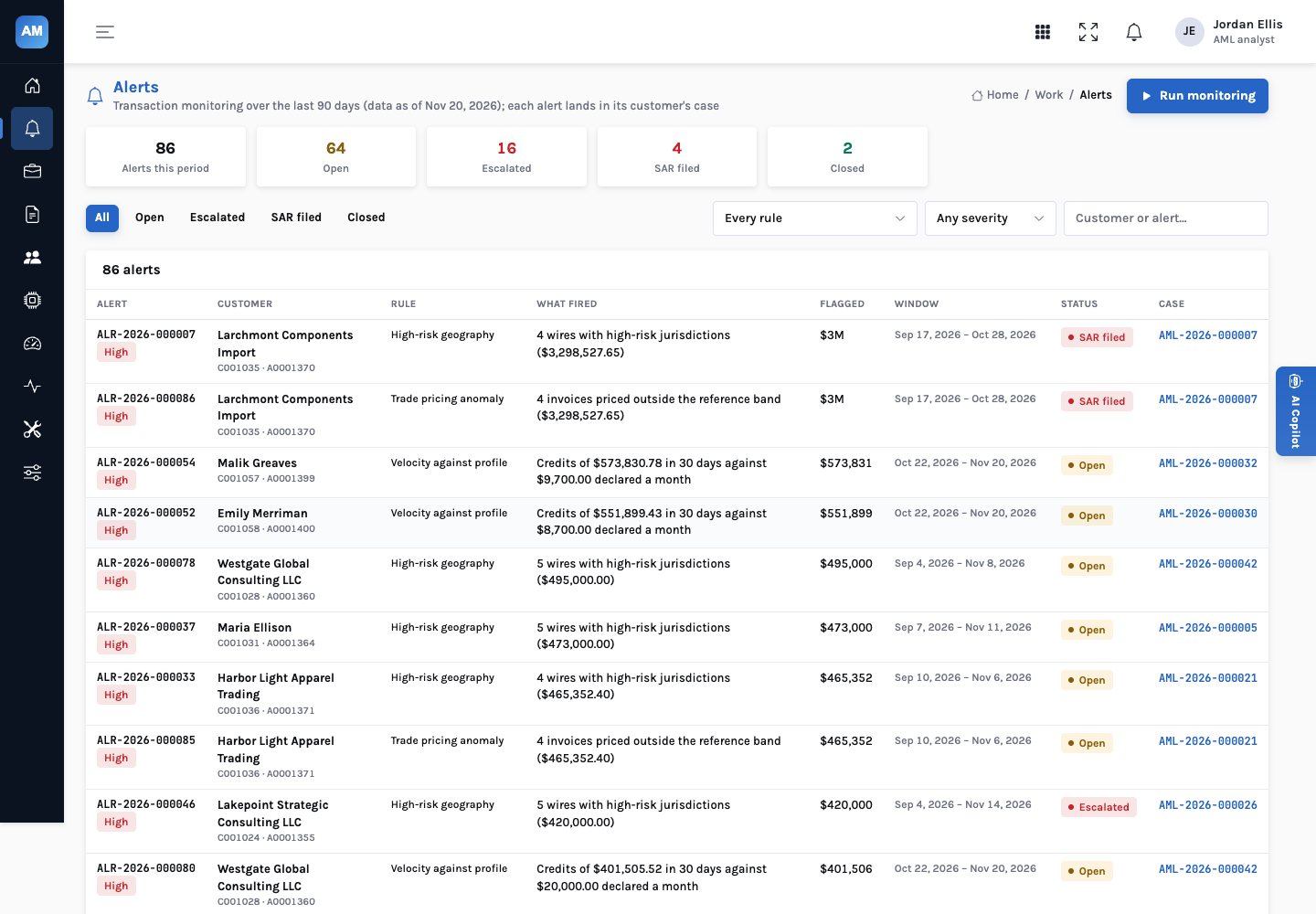
Monitoring reads the last 90 days of the bank’s transactions (AML_REVIEW_DAYS) rule by rule. Every alert keeps the transactions behind it and the figures the rule computed, so an investigator reads the evidence on the alert instead of rebuilding it. A rerun doesn’t duplicate an alert; an open alert is refreshed.
- Evidence on the alert — the transactions, counterparties, branches and countries, one click away
- Computed figures — how many deposits, how much moved out and how fast, how many times the profile
- Parameters in plain sight — each rule’s parameters and version shown on the tuning page
- Illustrative defaults — set them from your own risk assessment; a lead tunes them with a reason
Cases and triage
One case per customer, ordered by a score that lists its points
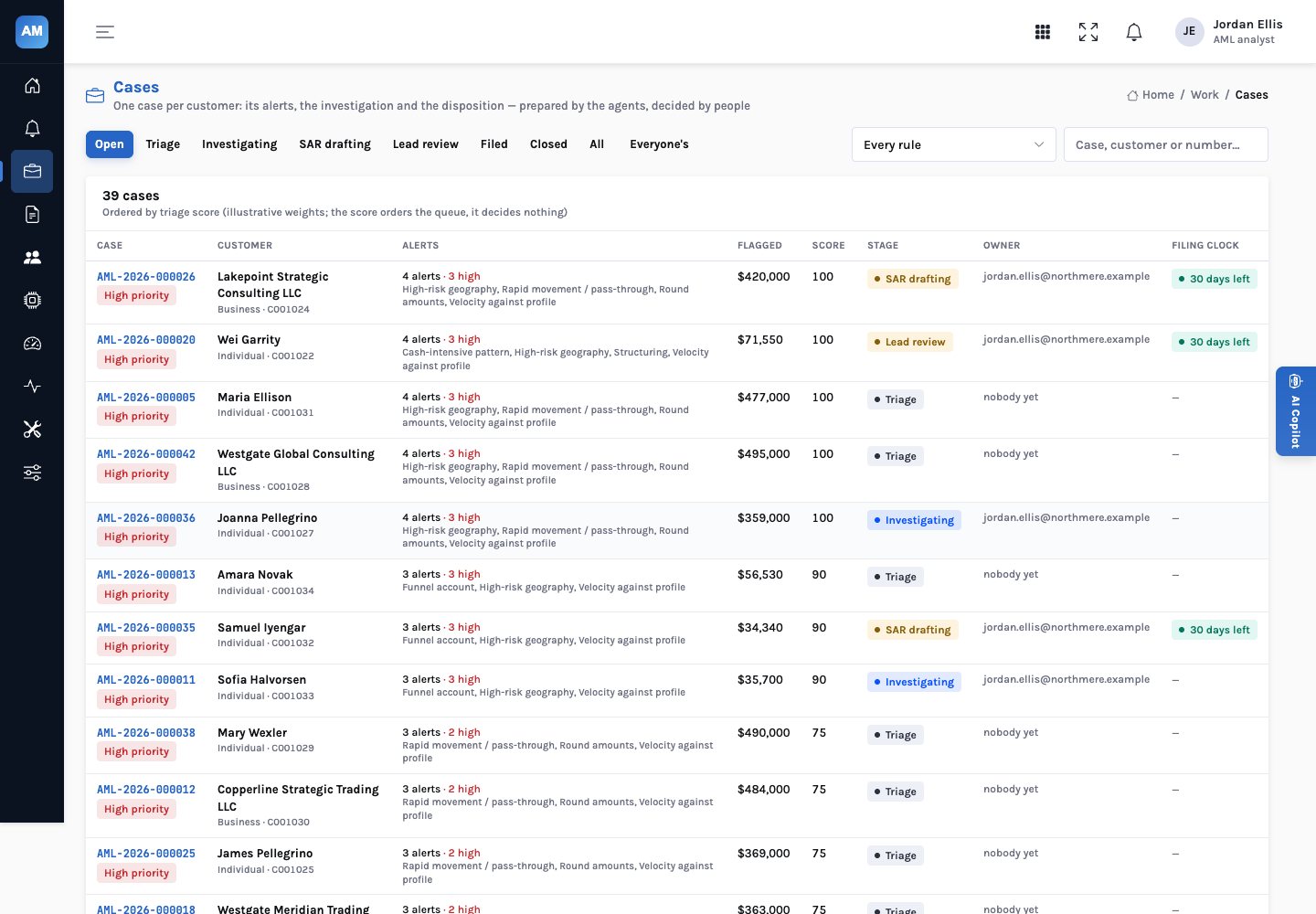
Every alert lands in its customer’s open case; one is opened when there is none. The queue is ordered by a triage score whose weights are illustrative and shown: points per alert by severity, a prior SAR, a high KYC rating, wires with a prohibited jurisdiction. The score orders the queue. It decides nothing.
- Stages — triage, investigating, SAR drafting, lead review, SAR filed, closed
- Priority — high at a score of 60 or more, or with a watchlist link or a prohibited jurisdiction
- Owner — a person takes the case; the triage agent can prepare that for them
- Filing clock — on every escalated case in the queue: days left, due soon, overdue
Investigation
The network, the timeline and the profile, on one page
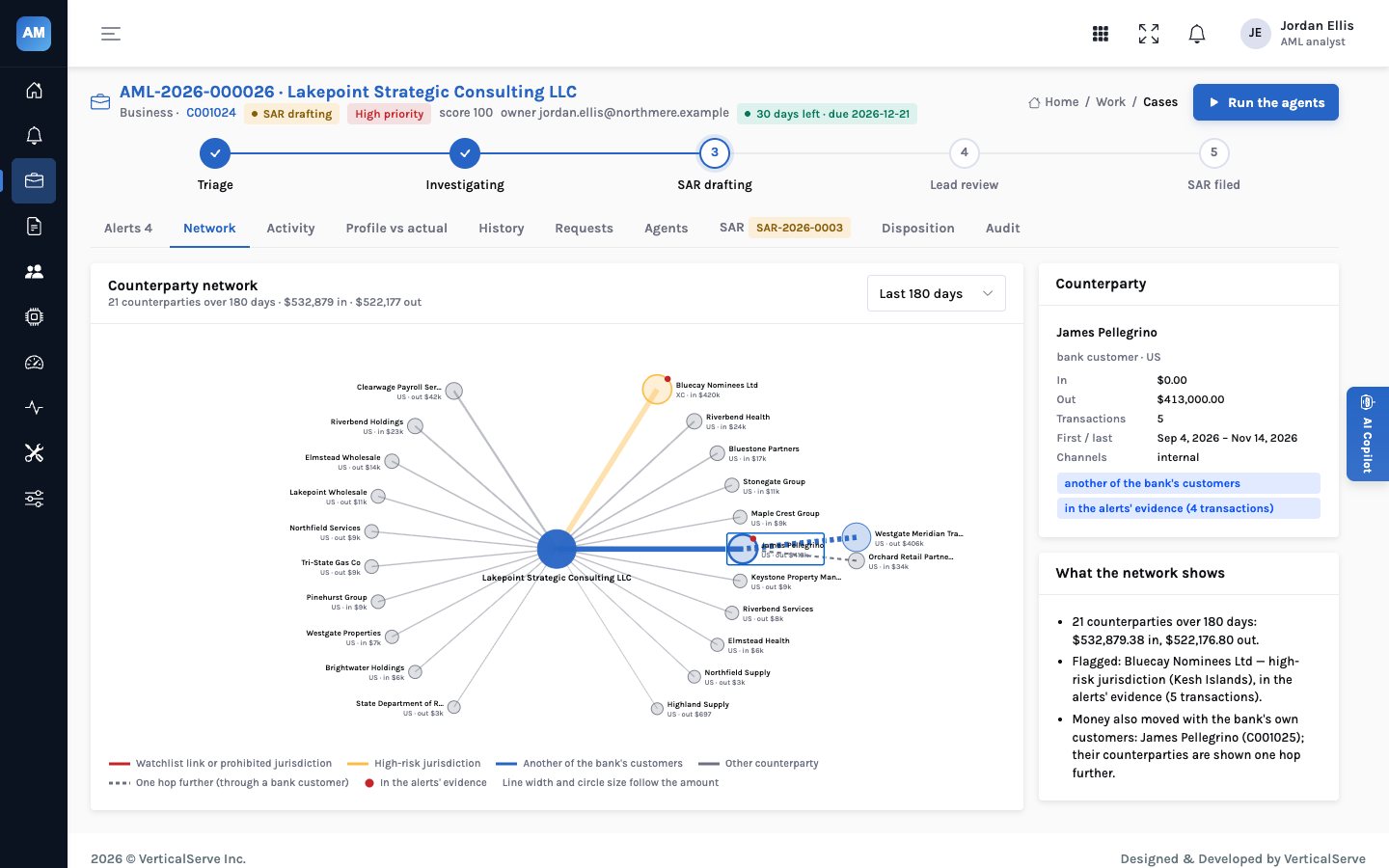
The counterparty network shows who money came from and went to over 180 days, flags high-risk jurisdictions, watchlist links and the alerts’ evidence, and follows the bank’s own customers one hop further, so a chain through several accounts at the same bank shows up. The timeline marks every day with an alert’s transaction.
- Network — line width and circle size follow the amount; click a counterparty for its totals
- Timeline — daily credits and debits, cash days, and the alerts’ transactions listed beneath
- Profile against actual — the last 90 days scaled to a month against what was declared at onboarding
- History — prior SARs, the legacy system’s alerts and how each closed, earlier cases
Profile against actual
What the customer said, beside what the account did
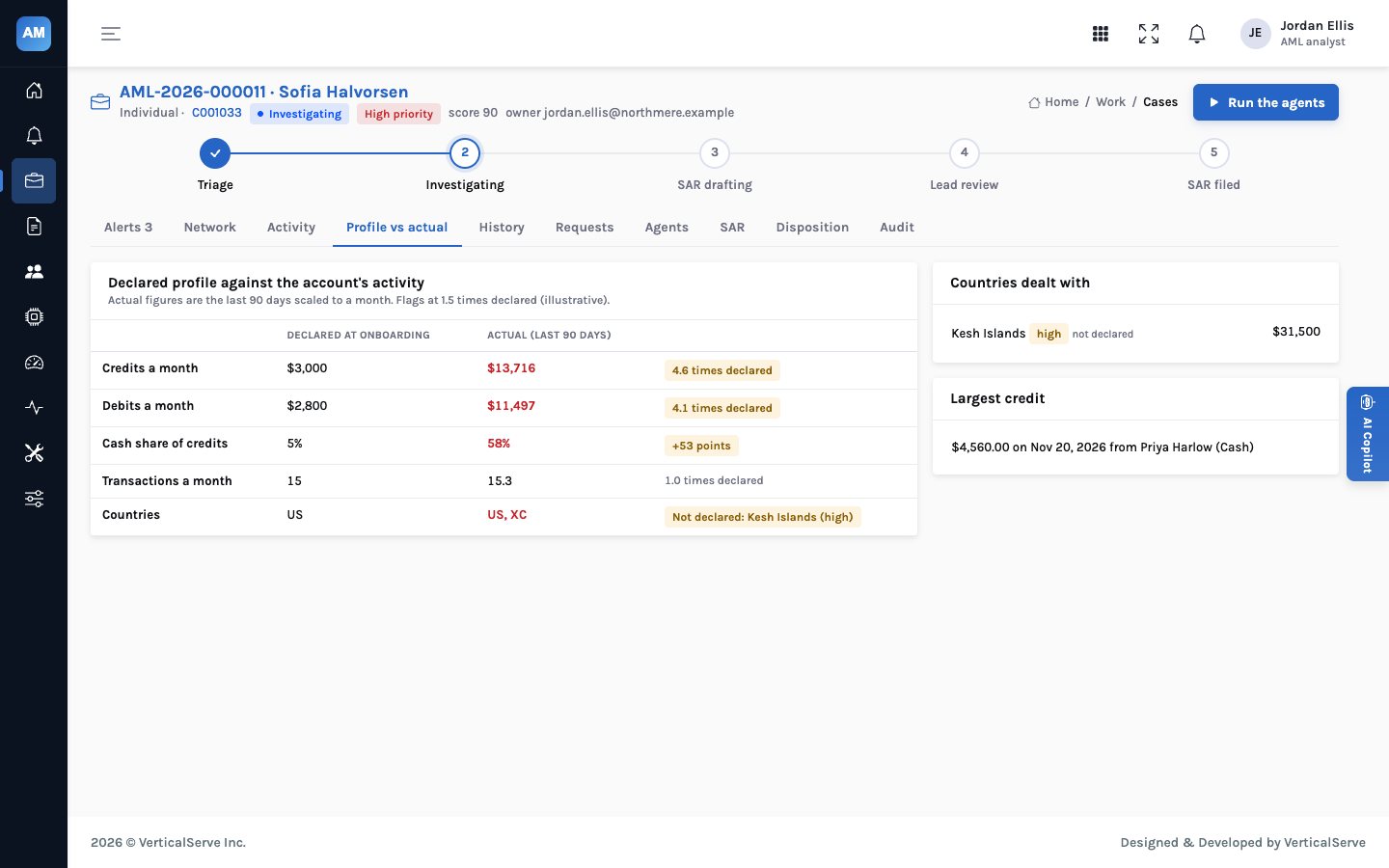
The declared profile from onboarding (monthly credits and debits, cash share, transaction count, countries) beside the last 90 days. A difference over 1.5 times declared, or a cash share 20 points over, is flagged; the tolerance is illustrative. The profile comparison agent turns the gaps into a question for the relationship manager.
- Credits and debits — scaled to a month, with how many times the declared figure
- Cash share — the points over or under what was declared
- Countries — undeclared countries named, with their risk level
- Largest credit — its date, amount and source
Dispositions
Close or escalate, each with a reason, and some closures go to a lead
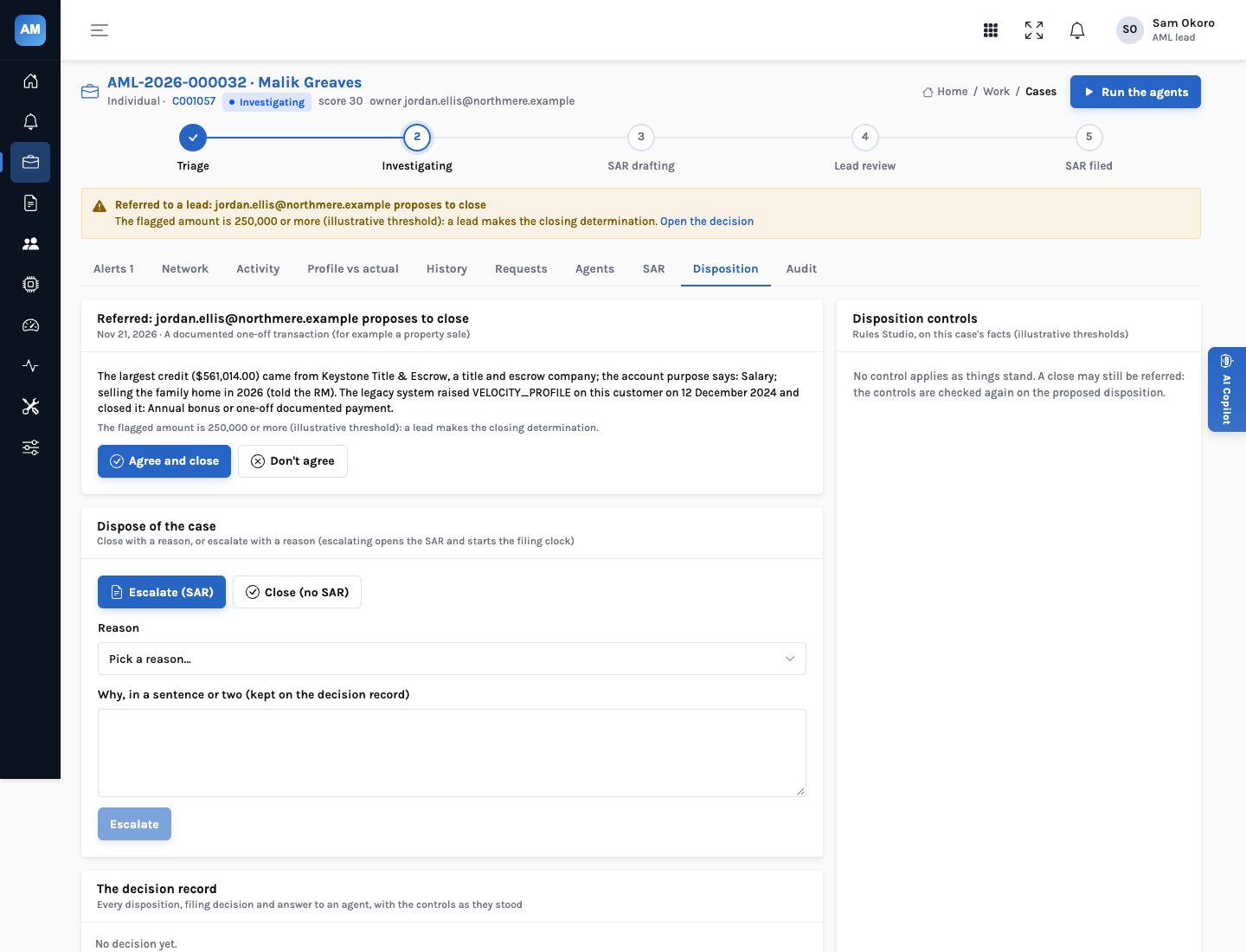
An investigator closes the case with one of eight close reasons or escalates it with one of eight escalation reasons, and says why in a sentence or two. Disposition controls from Rules Studio run first: closing a case with a watchlist connection, wires to a prohibited jurisdiction, a prior SAR or a flagged amount of 250,000 or more (an illustrative threshold) is referred to a lead.
- Close reasons — explained by the profile, legitimate business, seasonal, payroll, a documented one-off, an RFI answer, insufficient indicators, duplicate
- Escalation reasons — structuring, layering, funnel or mule, trade-based, watchlist connection, high-risk geography, profile or cash inconsistent
- Referral — a referred closure waits on the case for a lead, who agrees and closes, or declines with a reason
- Decision record — every control’s outcome, fired or not, kept with the determination
SAR narrative
Who, what, when, where, why and how, from the facts
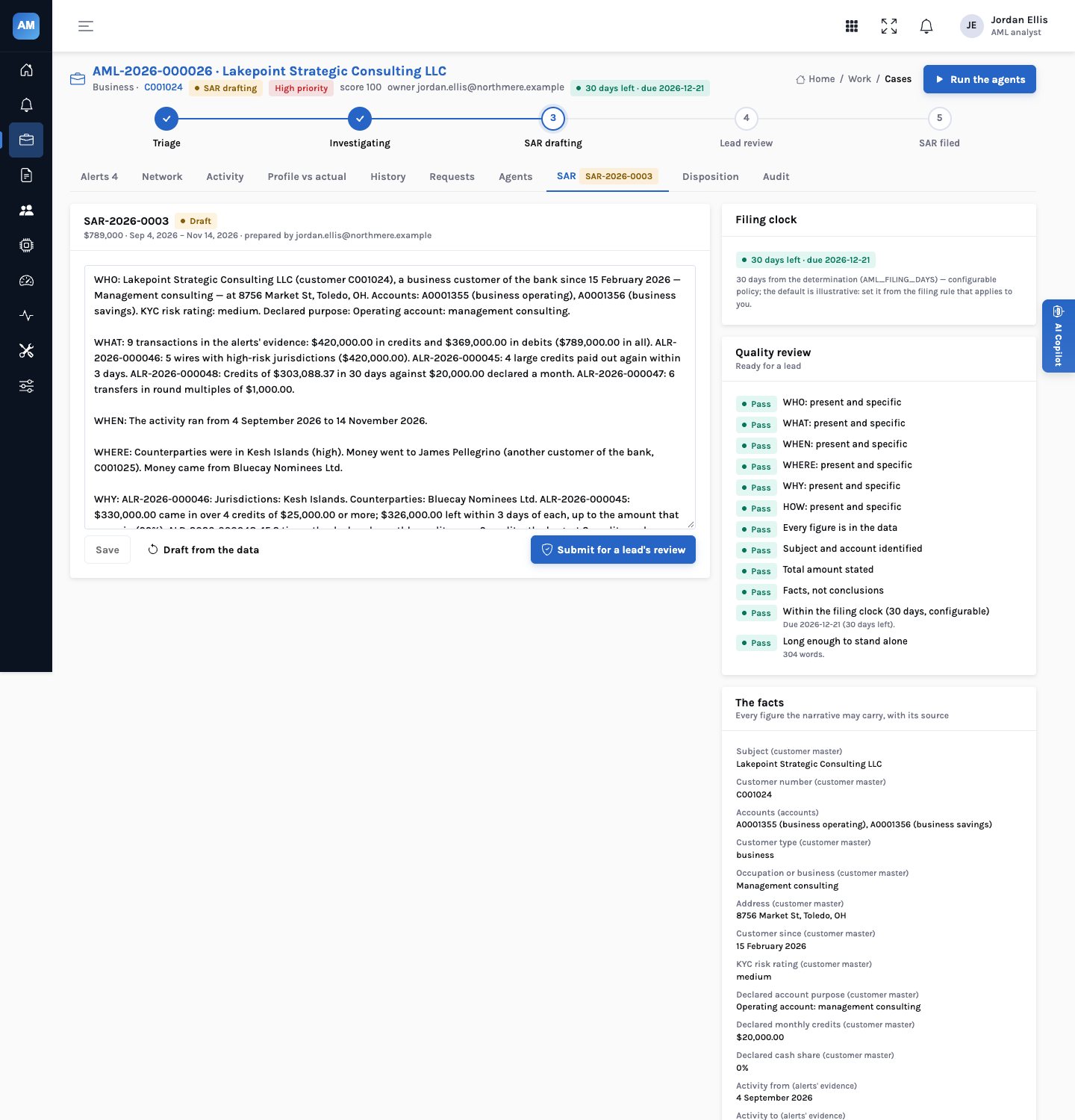
Escalating opens the SAR and starts the filing clock. The narrative is drafted in six parts from a list of facts, each with its source: the customer master, the accounts, the alerts’ evidence, the transactions, answers to requests for information and prior SARs. The quality review checks twelve things, from the six elements to every figure being in the data.
- Facts panel — every figure the narrative may carry, and where it came from
- Quality review — six elements, figures, identifiers, total, wording, the clock, length
- Blocks — a missing element or a figure not in the data blocks filing
- Warnings — conclusory words, an open request or a passed deadline are warned
Four eyes and the clock
A lead who didn’t prepare it files it
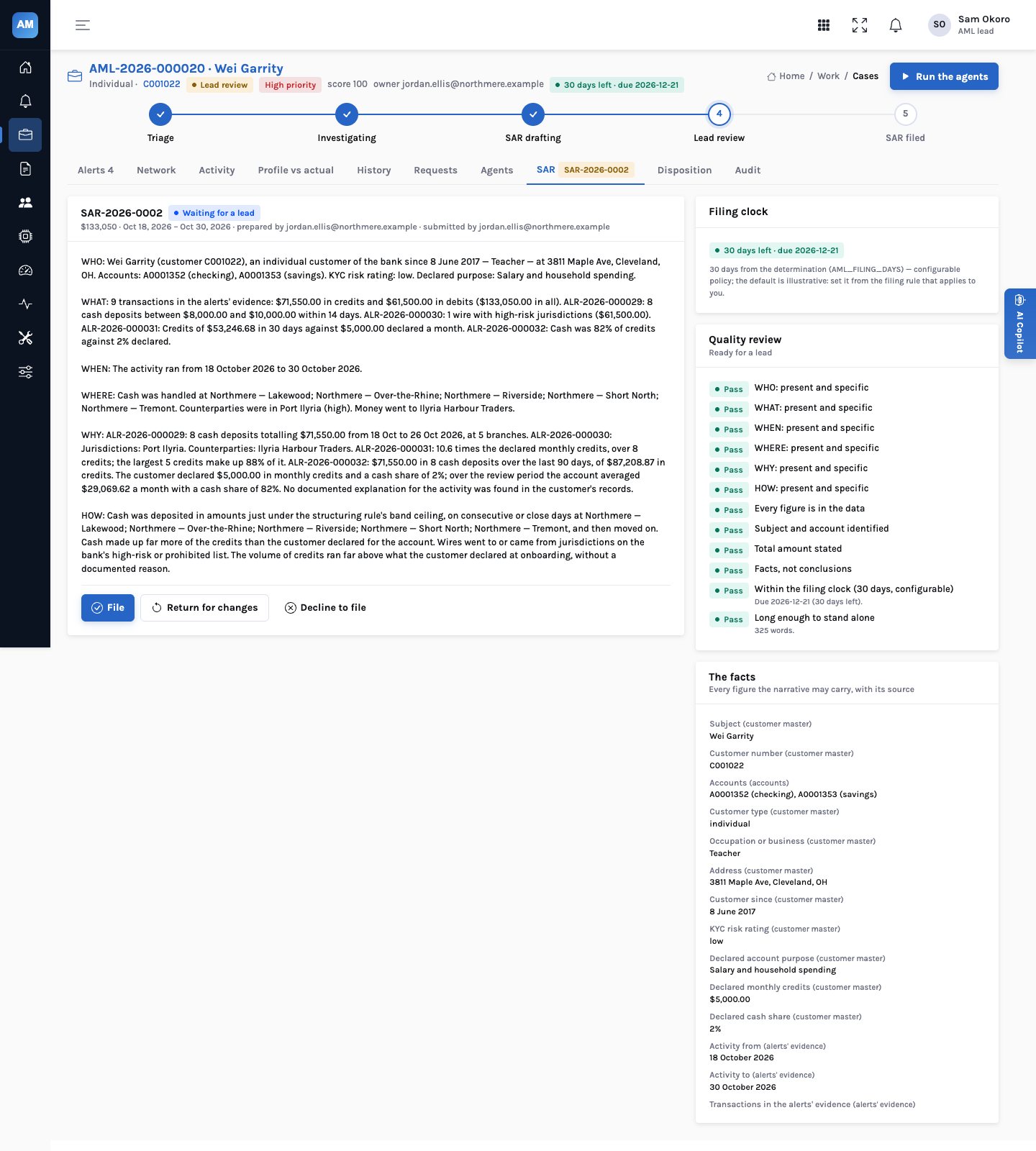
The analyst submits the SAR. A lead (the identity role curator, or an administrator) who neither prepared nor submitted it files it, returns it for changes or declines to file, with a note. The clock runs 30 days from the determination by default (AML_FILING_DAYS); that default is illustrative, to be set from the filing rule that applies to you.
- File — recorded in InsightAML with a filing reference; the submission to the regulator happens outside it
- Return — back to drafting with the lead’s note, counted on the SAR
- Decline — the case closes with the lead’s reason on the record
- Overdue — warned, and the filing note has to say why
Requests for information
Ask the relationship manager or the customer, without tipping anyone off
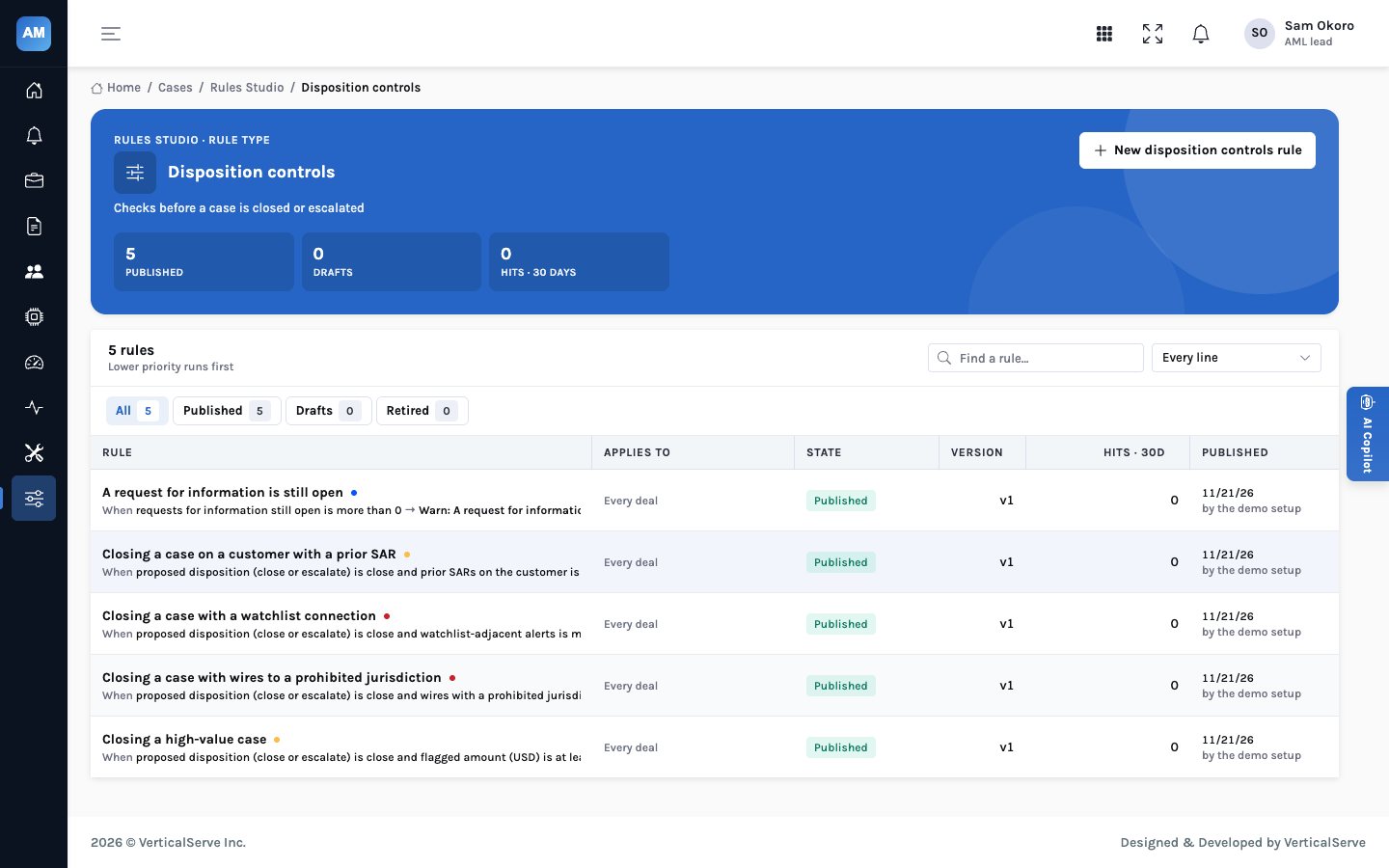
Agents draft questions about profile gaps and counterparties; an investigator can write one too. Requests are held until a person releases them. The recipient answers through a no-login link; the customer’s page shows a request reference, never the case. A message to a customer that mentions suspicion, an investigation, a SAR, money laundering or a report to the authorities can’t be sent.
- Held for review — agents never send; a person releases each request
- Link — created when the request is released, stored only as a hash, withdrawn in one click
- Answers — text and PDF uploads; the answer becomes a fact the narrative can quote
- Delivery — in the demo the analyst copies the message and link to the recipient
Rule tuning
Alert-to-SAR rates, close reasons, and changes with a reason
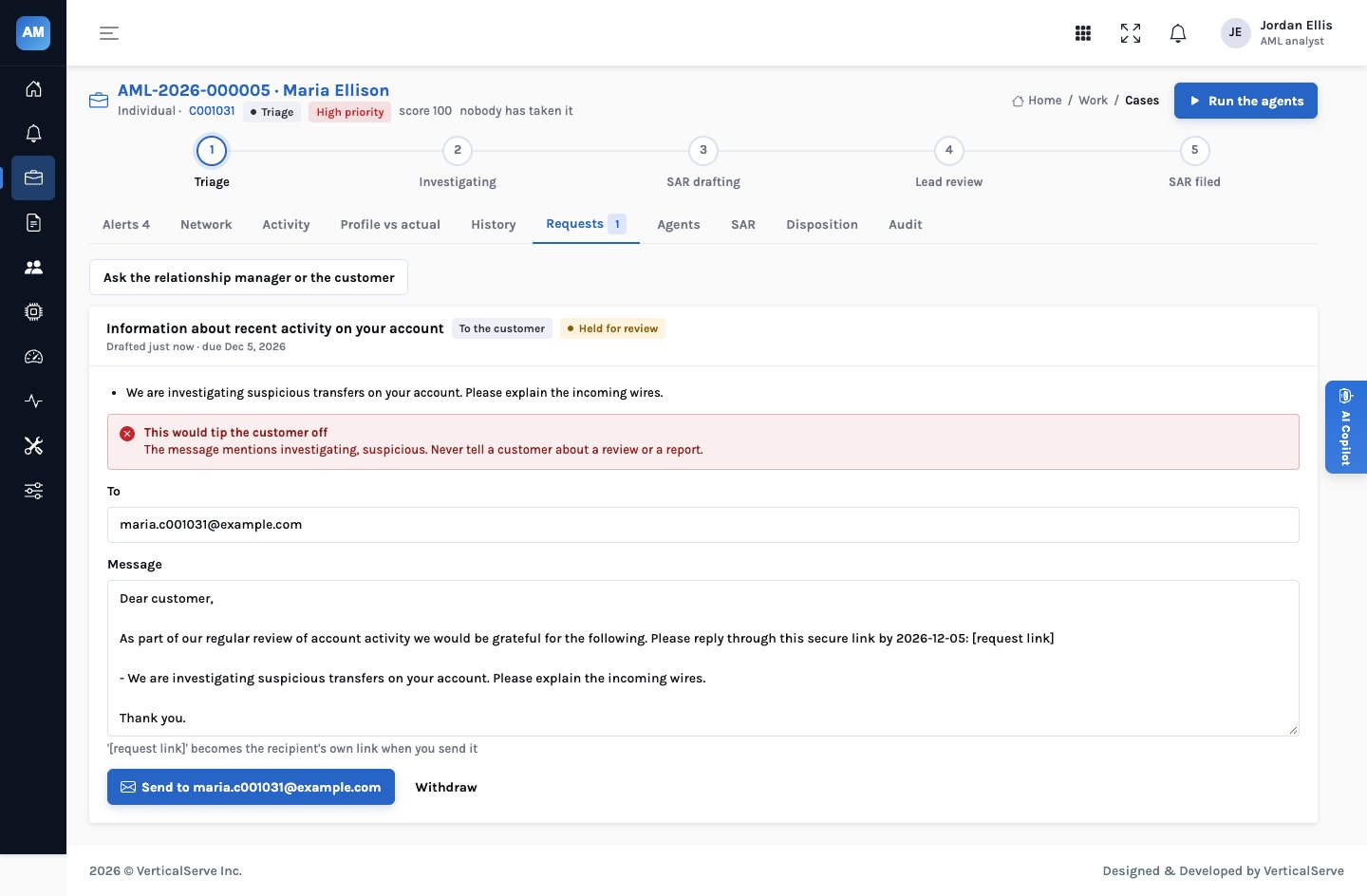
For every rule: the alerts this period and what became of them, the legacy system’s two years of alerts and SARs, the alert-to-SAR rate of each, and the most common reasons alerts were closed. A lead changes a parameter with a reason; the rule gets a new version and the old one stays in its history. The tuning analyst prepares proposals with their effect on this period’s alerts.
- Yield — alerts that became SARs, per rule, this system and legacy
- False positives — the close reasons behind them, counted
- Versioned — every change keeps who, when, why and the parameters
- Lead only — agents can propose a change; only a lead or an administrator applies one
Rules Studio
The controls are policy you can read
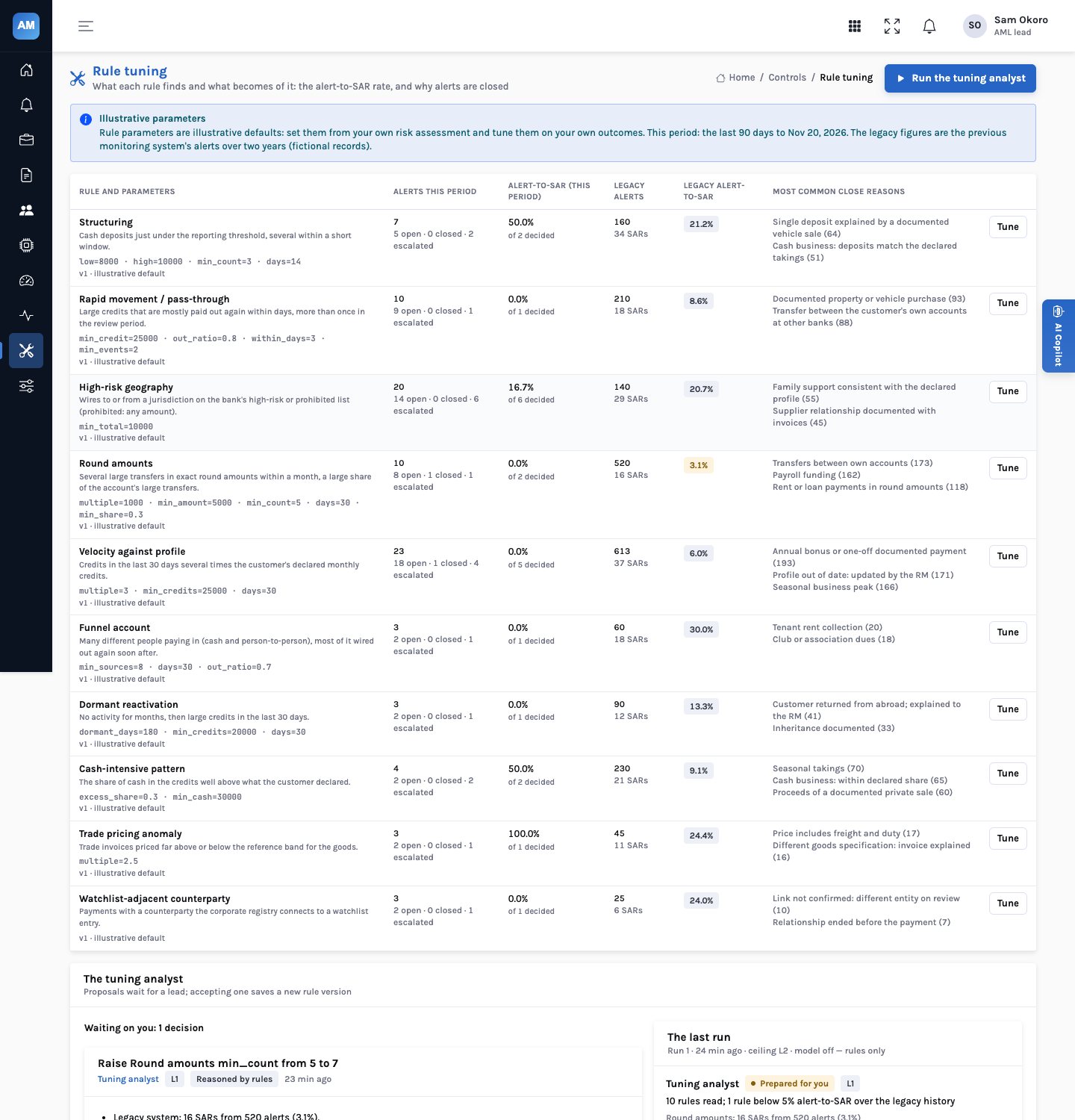
Disposition controls and filing controls are rules in Rules Studio, the same studio the other Insight products use: a condition over the case’s facts and an effect (refer, warn or block). They are tested against a real case before they are published, and every version is kept.
- Disposition controls — five, illustrative: watchlist, prohibited jurisdiction, prior SAR, high value, open request
- Filing controls — five, illustrative: missing element, unsupported figure, conclusory wording, overdue, open request
- Tested — against any case before publishing
- Recorded — each control’s outcome goes on the decision record
Copilot
Ask about the case in front of you
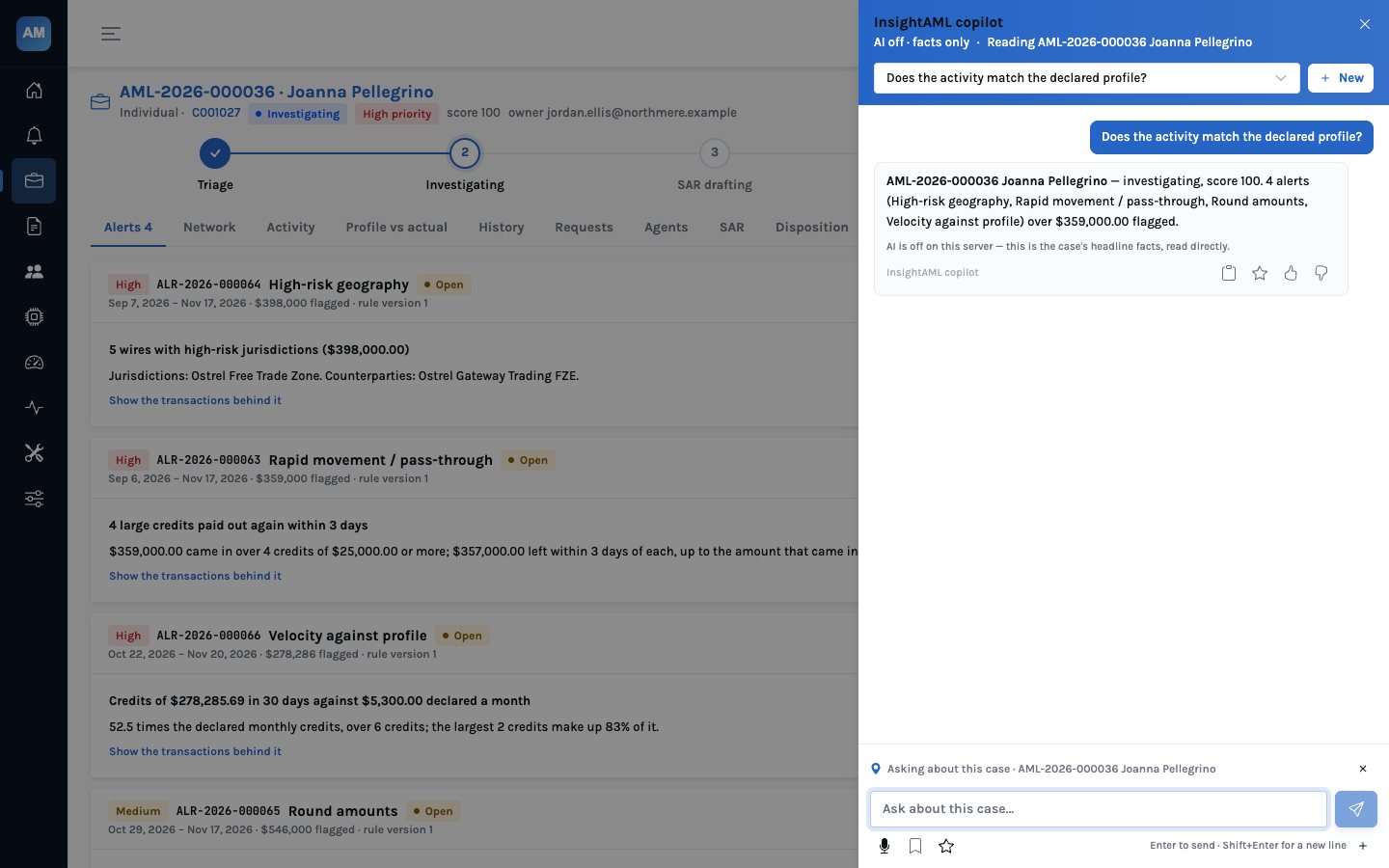
The copilot answers questions about the open case with eight read-only tools: the case summary, its alerts, the counterparty network, the profile comparison, the customer’s history, the SAR draft, what the agents found and the requests for information. It reads; no tool closes, escalates, files, sends or tunes anything.
- Grounded — each amount, date and count in an answer is checked against what the copilot read
- Read-only — it can point you to a tab; you decide there
- Model optional — with no model configured it answers with the case’s headline facts, and says so
- Suggested questions — why this customer was alerted, whether activity matches the profile, what the SAR still needs