An investigator who can’t explain a pattern of payments has two places to ask: the relationship manager, and the customer. Asking the customer is often the fastest way to an innocent explanation. It is also where an investigation is most easily compromised, because every regime that requires a suspicious activity report also forbids telling the customer about it. This post covers what the rule says, where it bites in practice, and how InsightAML builds a guard into the request itself.
In short
- The rule is universal. FATF Recommendation 21 asks countries to prohibit disclosing that a report is being or has been filed; the US, UK and EU all do.
- The risk is in ordinary messages. A well-meant email that mentions a “review” or an “investigation” can tell a customer exactly what the bank suspects.
- InsightAML refuses to send a customer message that names the review. Words such as suspicious, SAR, money laundering and investigation block the send until the message is reworded.
- A word list is a backstop, not a judgement. A neutral question can still tip someone off. The person who sends the request remains responsible for it.
What the rules say
data
United States: a bank, and its directors, officers, employees and agents, may not notify any person involved in a transaction that the transaction has been reported, and a SAR and any information that would reveal its existence are confidential. United Kingdom: in the regulated sector it is an offence to disclose that a suspicious activity report has been made, or that a money-laundering investigation is being contemplated or carried out, where the disclosure is likely to prejudice an investigation. FATF Recommendation 21 asks countries to prohibit such disclosure by financial institutions, their directors, officers and employees.
Sources: 31 U.S.C. 5318(g)(2) and 31 CFR 1020.320(e); Proceeds of Crime Act 2002, section 333A; FATF Recommendation 21. EU rules carry an equivalent prohibition, now in Regulation (EU) 2024/1624, which applies from 10 July 2027. Each regime has narrow exceptions, for example disclosures within a group or to a supervisor.
The UK offence turns on whether the disclosure is likely to prejudice an investigation; the US prohibition is written around the report itself. In practice banks treat both the same way: never tell the customer, or anyone outside those who need to know, that a report has been or may be made, or that the customer’s activity is under review for that reason.
Where it goes wrong
Few tipping-off risks come from a deliberate disclosure. They come from ordinary writing. An investigator under time pressure drafts “we are reviewing some suspicious transfers on your account”. A relationship manager who was asked a question by compliance mentions it to the customer over lunch. A customer portal shows a case reference that reads like an investigation number. Each is an attempt to be helpful.
Whatever the investigator writes is sent. Nobody checks the wording, the link exposes an internal reference, and the reply arrives as an attachment in someone’s inbox.
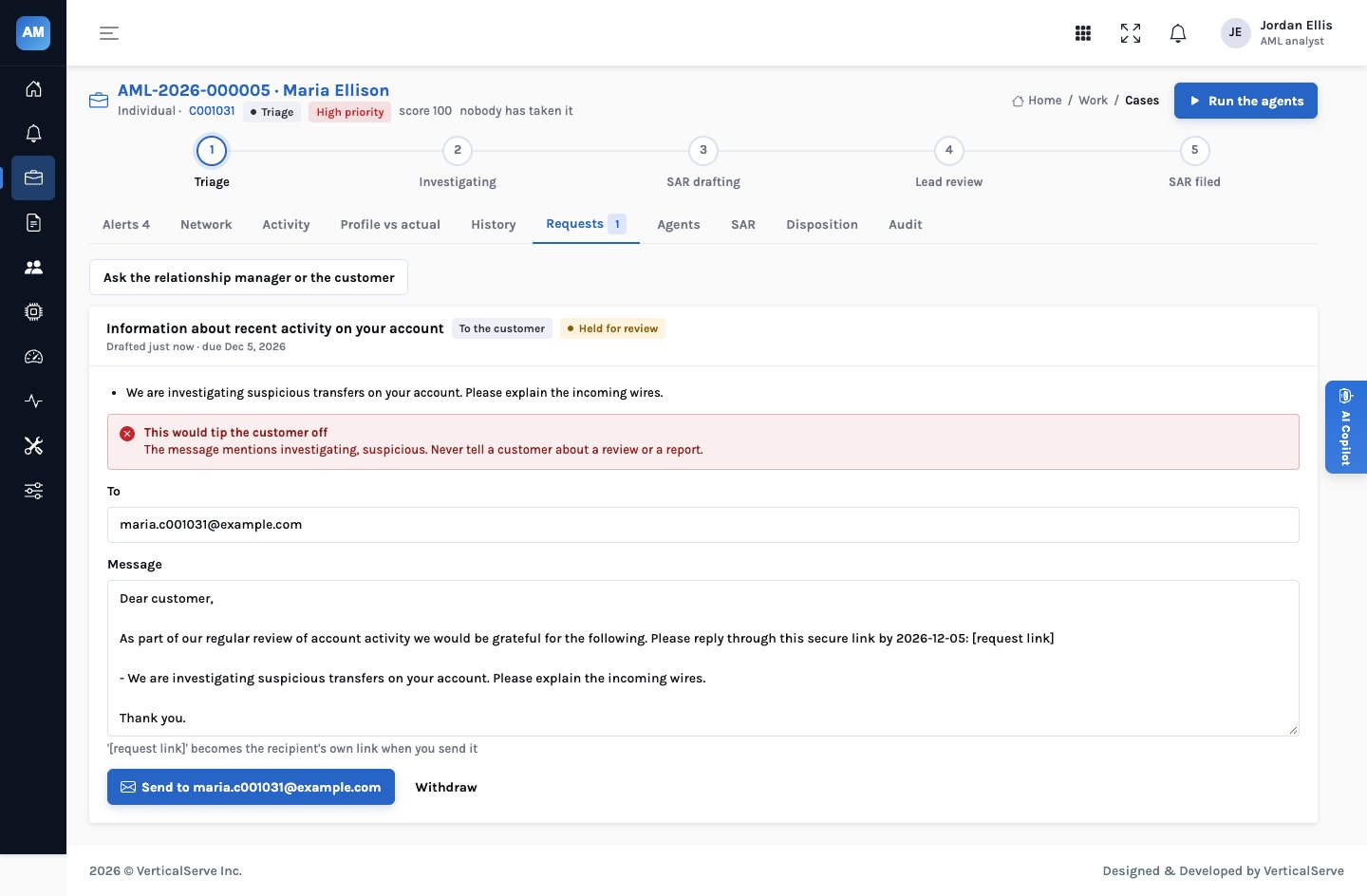
The customer’s message is checked for words that name the review; it can’t be sent until reworded. The customer sees a neutral reference, not the case number, and answers through their own link.
How the guard works
Requests for information in InsightAML go to one of two recipients: the relationship manager, or the customer. The profile and network agents draft them when they find a gap they can’t explain; an investigator can write one too. Every request is held on the case until a person releases it. Agents never send.
Customer requests pass a wording check before they can leave; nothing leaves without a person.
For a customer request, the subject, the message and every item are checked against a list of words that would reveal the review: suspicious, suspicion, SAR, money laundering, any form of launder, investigation, investigating, and reported to the authorities or to the regulator. If any appear, the case page shows the warning and the send is refused with the words it found. The default customer message is written to be neutral: “as part of our regular review of account activity”.
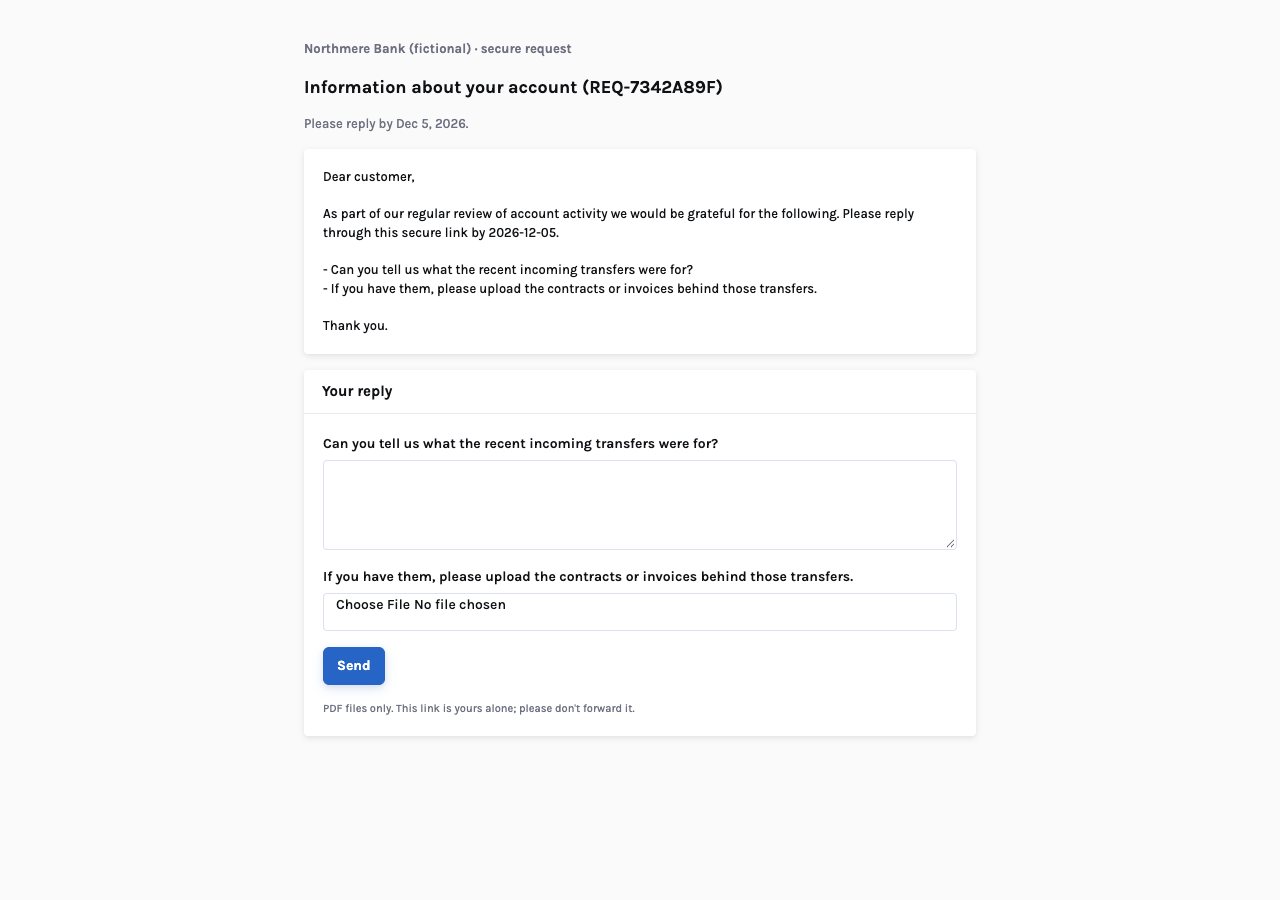
When a request is sent, InsightAML creates a link for that request alone and keeps only a hash of
its token. What the customer sees is the bank’s name, the message, a reference of the form
REQ- followed by eight characters, the due date, and a box or an upload for each item.
The case reference is shown only on requests to the relationship manager, whose default message also
ends: “Please don’t discuss this review with the customer.”
The RM often knows the explanation: a house sale, a new contract, a family arrangement. Their request shows the case reference and reminds them not to discuss it.
“What were the recent incoming transfers for?” rather than anything that names a rule, a typology or a counterparty you are worried about.
A customer message naming the review can’t be sent. Reword it.
The person who sends it is recorded on the case, with the time.
Answers and uploaded PDFs land on the request; answers become facts the SAR narrative can quote.
The limits of a word list
A list of words catches the obvious mistake. It doesn’t know that asking a customer about one particular counterparty, days after a large wire to it, may tell them what the bank is looking at. That judgement stays with the investigator who releases the request, and with your procedure for when contacting the customer is appropriate at all. Some cases should not involve the customer.
Answers become evidence
A request is not just a message. Its answer goes on the case, and InsightAML adds every answered item to the facts the SAR narrative may use, labelled with who answered it. In the demo bank’s funnel-account case, the relationship manager answered that the customer said friends were paying back shared rent, “but the amounts look too large for that”. That sentence is now a sourced fact, and the WHY section of a narrative can quote it.
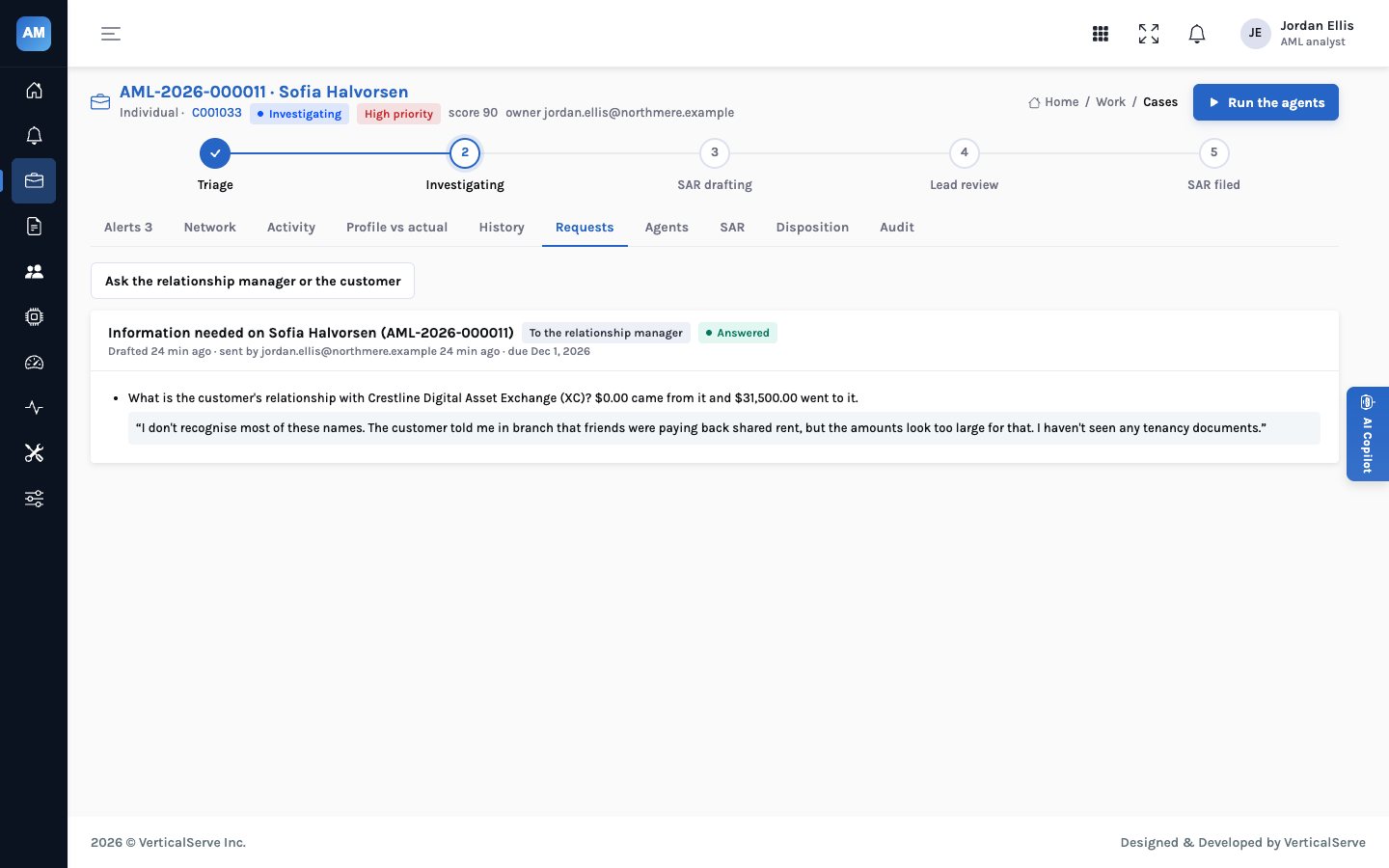
A request to the relationship manager on the demo bank, from draft to evidence.
Ask about the account. Never about the suspicion.
The prohibition on tipping off is short and absolute in effect. The way to honour it at scale is to make the safe path the default: requests held until a person sends them, neutral wording by default, a check that refuses the obvious mistake, and a reference that reveals nothing.